
Science
Newly discovered iron minerals might hold primordial water from when Earth formed
Key Points
Newly discovered iron minerals might hold primordial water from when Earth formed Researchers may have found a missing link in how Earth's mantle gets wet: newly discovered iron minerals that can store water at the extremely high temperatures and pressures present near our planet's core. Newly discovered iron minerals could be the missing link in how water is stored in the deepest parts of Earth's mantle and transported to the upper layers, recent research reveals. The findings are crucial...
Newly discovered iron minerals might hold primordial water from when Earth formed
Researchers may have found a missing link in how Earth's mantle gets wet: newly discovered iron minerals that can store water at the extremely high temperatures and pressures present near our planet's core.
Newly discovered iron minerals could be the missing link in how water is stored in the deepest parts of Earth's mantle and transported to the upper layers, recent research reveals. The findings are crucial for understanding the mantle's motion, volcanic activity and the workings of other rocky planets, the study authors say.
The researchers discovered the iron minerals, called iron oxyhydroxides, by squishing mineral samples between two tiny diamond anvils while zapping them with a laser.
The two iron minerals are stable at the conditions found at the boundary between Earth's core and its mantle (the planet's middle layer), which is under "more than a million times the pressure we feel at the surface," Steve Jacobsen, a mineralogist and professor of Earth science at the University of Colorado Boulder who was not involved in the study, told Live Science in an email.
The new minerals contain as much as 15% water by weight. "If you add up all the H and O atoms in the formula and combine them into H2O, just a five-pound piece of the stuff would contain a pint of liquid water," Jacobsen added. "If this material existed in the early Earth, spread out across the base of the mantle, even just a few percent of it would potentially be enough to supply the formation of the oceans."
A tectonic mystery
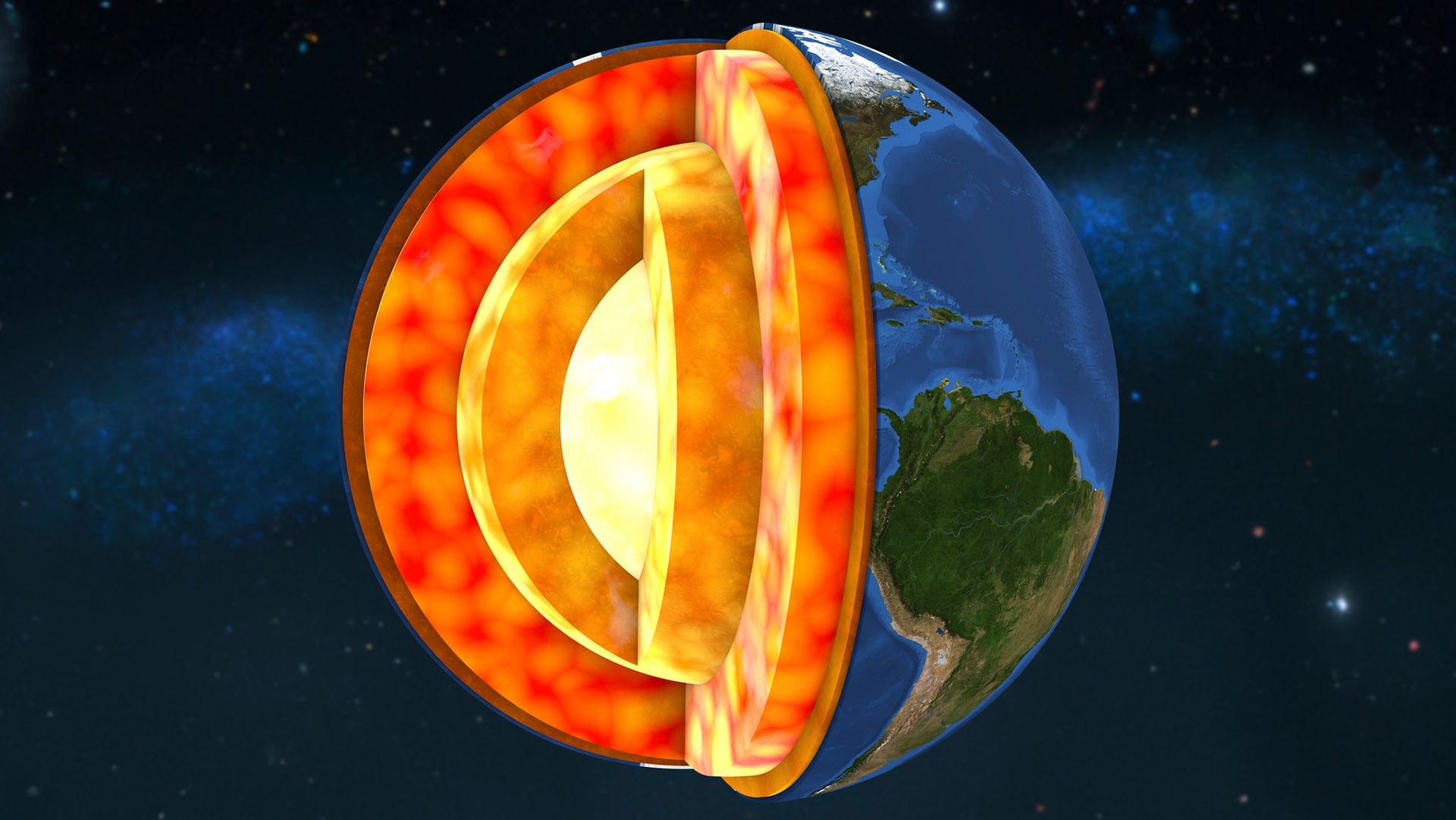
Earth contains multiple layers, like an onion. The crust is the thinnest layer (the onion skin), and it moves around very slowly on top of a giant ocean of molten rock called the mantle (the juicy part of the onion). Deep in the heart of that ocean is the planet's core, like an onion's center, if the center of the onion were made of superheated iron and nickel crushed under the weight of a planet.
Water in the mantle makes the molten rock stretchier, which means the mantle can change its shape and convect. That's a big part of why Earth has plate tectonics — without water in the mantle, the material is too stiff to move around and drag the planet's crust with it. We know there's water in the mantle; however, we don't know exactly what the water in the mantle is doing.
There are two main theories for how water gets into Earth's mantle. The first is through subduction: When one tectonic plate sinks under another, it brings water from the surface into the mantle. The second is primordial water, left over from the planet's formation, that's stored near the boundary between Earth's core and the lower mantle.
Get the world’s most fascinating discoveries delivered straight to your inbox.
Related stories
The newly discovered minerals match both major theories for how Earth got its mantle water. They're dense enough to sink all the way to the bottom of the mantle, which fits with subduction and provides a way for water to enter Earth's core. The iron minerals are also strong enough to withstand the extremely high-energy impacts that they would have experienced if they were present while Earth was forming.
The mantle's convection could bring these minerals from near the core to close to the surface in large mantle plumes, where the minerals would melt and release their water, thus completing the water cycle in the mantle and contributing to volcanic hotspots at the surface. This process has implications for water cycles and theories of how other rocky planets and exoplanets — especially the weird ones that are mostly molten rock — formed.
Although the study, published Sept. 8 in the journal Nature Geoscience, doesn't prove that these minerals are taxiing water around the mantle, knowing that the iron minerals exist provides a pathway for the first time. The newly discovered minerals might also explain mysterious, extremely dense regions deep inside Earth —the "ultra-low seismic velocity patches we see sitting on top of the core-mantle boundary," Jacobsen added.
Yuan, H., Man, L., Kupenko, I., Yin, Y., Aprilis, G., Pantousas, A., Pakhomova, A., Zhou, W., Pierru, R., Yang, K., Glazyrin, K., Rodrigues, J. E., Garbarino, G., Ball, J. a. D., Bykova, E., Hu, Q., Sossi, P. A., Frost, D. J., & Dubrovinsky, L. (2026). Dense iron oxyhydroxides as possible reservoirs of water under deep mantle conditions. Nature Geoscience. https://doi.org/10.1038/s41561-026-02067-1
What is Earth made of? Find out with our inside Earth quiz!
Damien Pine (he/him) is a freelance writer, artist, and former NASA engineer. He writes about science, physics, tech, art, and other topics with a focus on making complicated ideas accessible. He has a degree in mechanical engineering from the University of Connecticut, and he gets really excited every time he sees a cat.
You must confirm your public display name before commenting
Please logout and then login again, you will then be prompted to enter your display name.