
Science
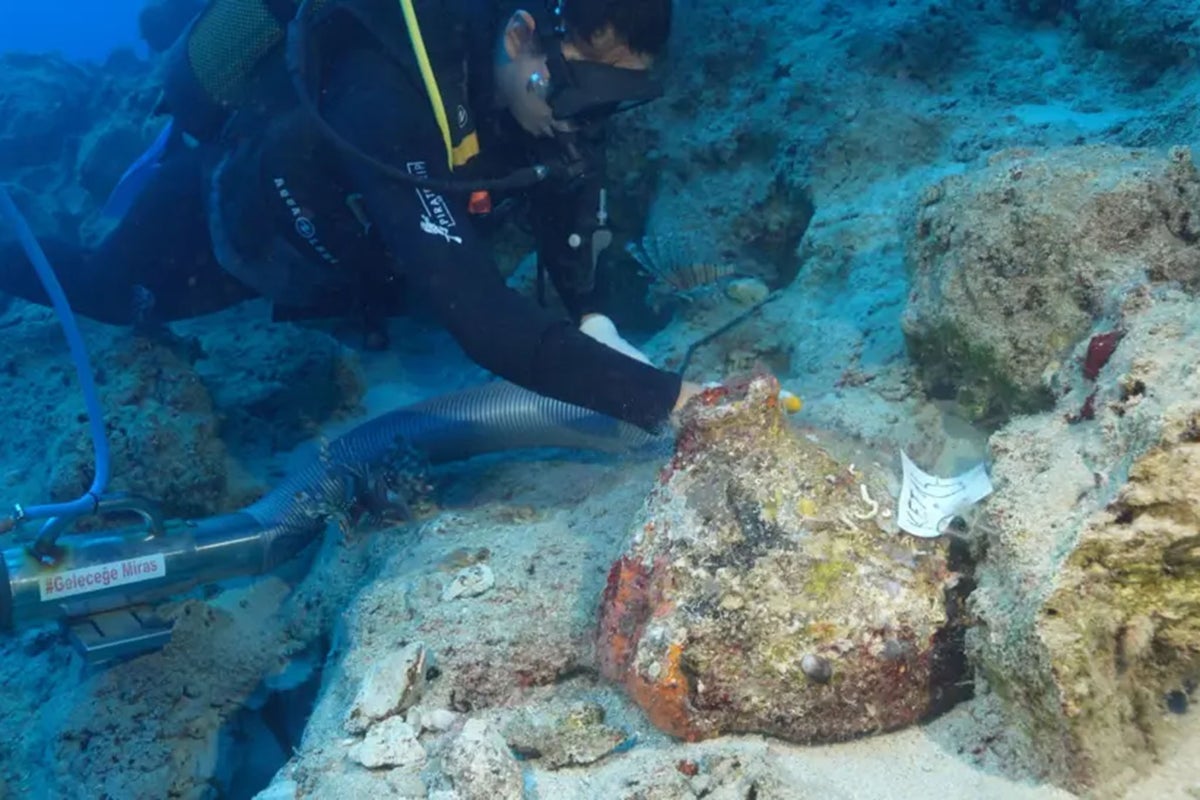
World’s oldest shipwreck discovered by archaeologists near Turkish island
Key Points
World’s oldest shipwreck discovered off coast of Turkey Early Bronze Age vessel was likely built around the same time as the Great Pyramid of Giza - Bookmark - CommentsGo to comments Become an Independent member to bookmark this article Already a member? Log in Archaeologists have found the world’s oldest-known shipwreck off the coast of Turkey, dating the Early Bronze Age vessel to between 4,400 and 4,700 years ago. The ship, built around the same time as the Great Pyramid, was likely a...
World’s oldest shipwreck discovered off coast of Turkey
Early Bronze Age vessel was likely built around the same time as the Great Pyramid of Giza
- Bookmark
- CommentsGo to comments
Become an Independent member to bookmark this article
Already a member? Log in
Archaeologists have found the world’s oldest-known shipwreck off the coast of Turkey, dating the Early Bronze Age vessel to between 4,400 and 4,700 years ago.
The ship, built around the same time as the Great Pyramid, was likely a trade vessel carrying cargo across the Mediterranean Sea, researchers from the Mediterranean Archaeology Association said.
While the wooden structure of the ship was gone, archaeologists dated the ceramic storage vessels and stone anchors found in the wreck off Kekova Island to 2600-2400 BC, making it the oldest shipwreck in the world.
It takes the title from the Dokos shipwreck in the Aegean Sea which dates to around 2200 BC.
The shipwreck was discovered during excavations led by underwater archaeologist Hakan Öniz from Akdeniz University in Antalya.
“Akdeniz University conducted a study of the Kekova region in the Demre district of Antalya, during which a shipwreck carrying Early Bronze Age amphorae was documented,” archaeologists noted in a study detailing the discovery in the Journal of Maritime Archaeology.
Some of these amphorae, which are large double-handled pottery vessels, are similar to Early Bronze Age pottery from the Levant, which includes modern-day Lebanon, Syria, Israel, and Palestine.
The ceramic vessels were found scattered across a partly sandy and partly rocky seabed at a depth of about 30m.
One vessel seemed similar to containers used for transporting agricultural products like wine and olive oil during the Bronze Age.
“The upper part of this amphora features two parallel lines made with a pointed tool, as well as a zigzag pattern in the middle,” archaeologists wrote.
Researchers also found two three-holed stone anchors and a single-holed anchor around the wreck, similar to those found at other Bronze Age sites.
“The three-holed stone anchors found in the wreck area resemble those seen in Bronze Age Minoan, Cypriot, Anatolian, Levantine contexts,” they stated, “while the single-holed stone anchor resembles those seen on the Bronze Age Anatolian and Levantine coasts
It was unclear if the anchors were indeed part of the ship, but they could shed more light on anchoring technology in use in the region during the Bronze Age.
“Current information suggests that the shipwreck is from a small vessel that sank while sailing east to west during the Early Bronze Age,” the study noted.
Join our commenting forum
Join thought-provoking conversations, follow other Independent readers and see their replies
Comments
World (ORG)
Turkish (ORG)
Turkey (LOCATION)
the Great Pyramid of Giza - Bookmark - CommentsGo (LOCATION)
Independent (ORG)
the Great Pyramid (LOCATION)
the Mediterranean Sea (LOCATION)
the Mediterranean Archaeology Association (ORG)
Kekova Island (LOCATION)
BC (ORG)
Dokos (LOCATION)
the Aegean Sea (LOCATION)
Hakan Öniz (PERSON)
Akdeniz University (ORG)
Antalya (LOCATION)