
Science
Scientists removed the glare from a James Webb telescope image — and unmasked a hidden planet
Key Points
Scientists removed the glare from a James Webb telescope image — and unmasked a hidden planet Using machine learning, astronomers developed a new way of looking at James Webb telescope data that allows far-off planets to emerge from their star's glare. When it comes to spotting planets orbiting distant stars, the biggest hurdle is often separating the signal from the noise — specifically, trying to distinguish a planet from the stellar glare around it. That's true even for the most...
Scientists removed the glare from a James Webb telescope image — and unmasked a hidden planet
Using machine learning, astronomers developed a new way of looking at James Webb telescope data that allows far-off planets to emerge from their star's glare.
When it comes to spotting planets orbiting distant stars, the biggest hurdle is often separating the signal from the noise — specifically, trying to distinguish a planet from the stellar glare around it. That's true even for the most sophisticated telescopes, including the James Webb Space Telescope (JWST).
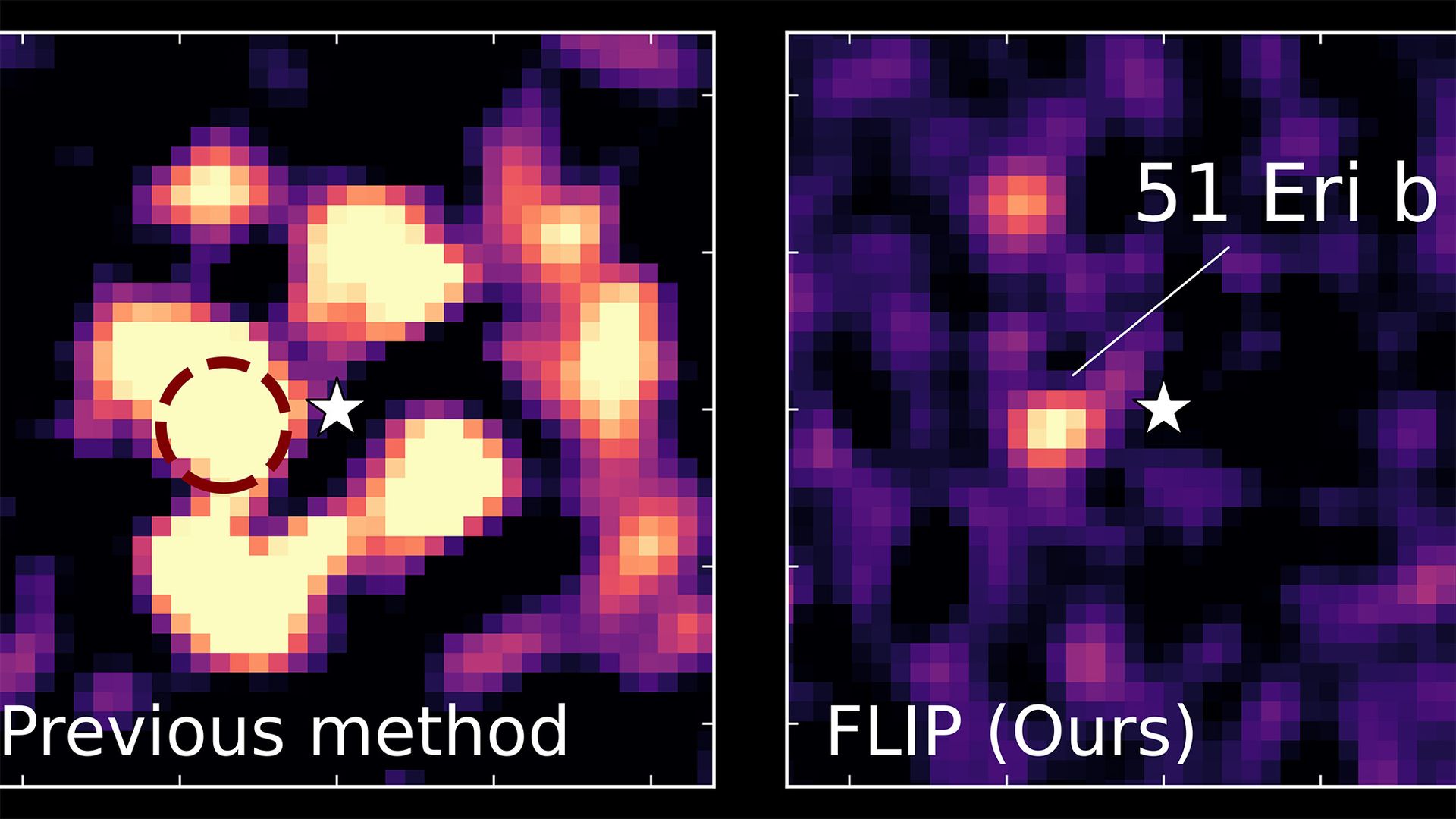
Now, astronomers have developed a new way to spot planets that were formerly drowned out in a sea of light. Using a combination of modeling and machine learning techniques, they picked out a previously hidden giant exoplanet in data from JWST. The results were published Nov. 4 in the journal Nature.
"Planets are a million times fainter than their stars," study first author Rodrigo Ferrer-Chavez, an astronomer at Northwestern University, said in a statement. "So, to image exoplanets, we need to remove that glare."
Telescopes like JWST use instruments called coronagraphs to block out some of this excess light, similar to the way the moon and a pinhole camera operate during a total solar eclipse. But even the best coronagraphs have limitations — for example, they can't block all the glare, and the telescopes themselves move.
Even the most stable telescopes vibrate almost imperceptibly as they collect light, so the images a telescope produces contain ever-so-slight mismatches compared with what the instrument actually sees. These slight shifts can be enough to obscure even very large exoplanets.
To address this, Ferrer-Chavez and his team developed a "digital twin" of JWST that virtually recreates how light travels through the telescope's detectors, minus any movement-based imperfections. To fine-tune this digital replica, the researchers used computational models based in real-world physics alongside machine learning techniques similar to those used to train AI. But the authors stressed that this is not an AI model.
"Because we already know the physics, we don't need AI to understand what's happening," study co-author Jason Wang, also an astrophysicist at Northwestern, said in a statement.
Get the world’s most fascinating discoveries delivered straight to your inbox.
- Astronomers detected radio signals coming from an exoplanet for the first time. Spoiler alert: It's not aliens.
- Newly confirmed 'baby planet' is the youngest alien world scientists have ever discovered
- 'It's absolutely exciting!': Astronomers discover an atmosphere around an Earth-like planet in the habitable zone for first time ever
The researchers named their approach Physics-based Learning for Imaging Planets, or FLIP.
Using FLIP, the team analyzed data from three stars, including 51 Eridani, which is located around 97 light-years from Earth and was already suspected to have a giant exoplanet orbiting it. Although the planet, called 51 Eridani b, had been detected by ground-based telescopes, it was drowned out by light in previous JWST observations. With FLIP, however, 51 Eridani b popped out from the dataset.
The scientists hope this approach will help astronomers pick out even more hard-to-spot exoplanets, especially ones that look like the planets in our own backyard. In the nearly 35-year history of exoplanet hunting, the vast majority of planets we've found have been radically different from those in our own solar system, partially because larger and more reflective worlds are easier to spot with current telescopes.
"It's not that [solar-system-like planets] don't exist," Ferrer-Chavez said. "It's that we can't see them."
Ferrer-Chavez, R., Wang, J. J., Bouman, K. L., Freeman, W. T., Pueyo, L., Feng, B. Y., & Perrin, M. D. (2026). Imaging exoplanets below the telescope stability limit. Nature, 659(8139), 58–62. https://doi.org/10.1038/s41586-026-11213-z
Joanna Thompson is a science journalist and runner based in New York. She holds a B.S. in Zoology and a B.A. in Creative Writing from North Carolina State University, as well as a Master's in Science Journalism from NYU's Science, Health and Environmental Reporting Program. Find more of her work in Scientific American, The Daily Beast, Atlas Obscura or Audubon Magazine.
You must confirm your public display name before commenting
Please logout and then login again, you will then be prompted to enter your display name.
[Image text:] 51 Eri b
Previous method
FLIP (Ours)