
Technology
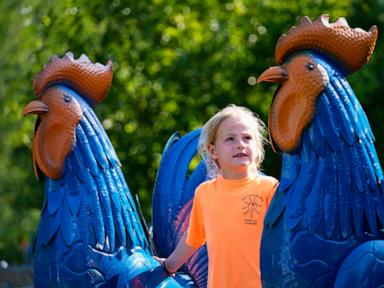
Maine parents sue town over autistic daughter's metal rooster statues
Key Points
Maine parents sue town over autistic daughter's metal rooster statues A fight over whether giant metal roosters in Maine are illegal advertising or artwork that comforts an autistic child has landed in federal court A fight over whether giant metal roosters in Maine are illegal advertising or artwork that comforts an autistic child has landed in federal court. David and Sara LeBlanc sued the town of Ogunquit this week, alleging that enforcement of its sign code violates their First Amendment...
Maine parents sue town over autistic daughter's metal rooster statues
A fight over whether giant metal roosters in Maine are illegal advertising or artwork that comforts an autistic child has landed in federal court
A fight over whether giant metal roosters in Maine are illegal advertising or artwork that comforts an autistic child has landed in federal court.
David and Sara LeBlanc sued the town of Ogunquit this week, alleging that enforcement of its sign code violates their First Amendment rights. They want to display the roughly 6-foot-tall (1.8 meters) ornaments for their daughter, Pyper, but the town considers them advertising for the couple's adjacent restaurant, the Omelette Factory.
“The roosters are a symbol of one thing: How much we love our daughter,” David LeBlanc said in a statement. “But the town made up an entirely different meaning for them.”
After issuing multiple fines, the town granted the couple a disability variance that allows them to keep two roosters but specifies that they must be attached to a railing. More fines followed when the couple declined to build a railing and chained them to two posts instead. They have since removed all of the tin statues, according to the lawsuit, which points out that other local businesses display lobster buoys, antique farm equipment and large tiki statues without incurring fines.
"This is governmental discrimination based on the content of speech and the identity of the speaker," the lawsuit states. “Such discrimination is presumptively unconstitutional, and the Town cannot justify it.”
The LeBlancs are represented by the Institute for Justice, which won a similar case in New Hampshire in 2025 when a judge sided with a bakery owner in a dispute over a large mural high school students painted on his building. The town of Conway had argued the mural featuring doughnuts and other baked treats was a regulated sign, but the judge found the town infringed on the bakery owner's free speech rights.
Ogunquit's town clerk, Christine Murphy, did not respond to a message seeking comment Wednesday. Meanwhile, many of the LeBlancs' original roosters have been adopted by local residents and businesses, and their supporters around the world have been buying their own to display.
“Every time Pyper spots another rooster in someone's yard, her face lights up,” Sara LeBlanc said in a statement. “This town has embraced her. We wish the town government would, too.”
____ Ramer reported from Concord, New Hampshire.