
Environment
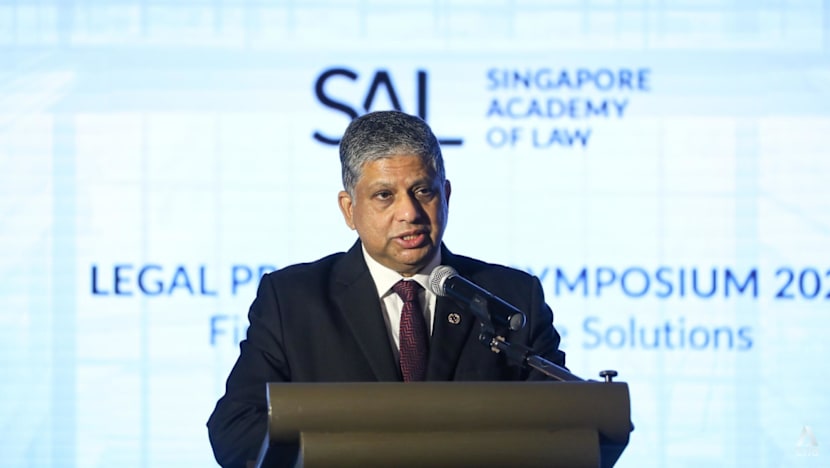
Harassment and bullying lawyers an unacceptable red line at work and at court, says incoming Chief Justice
Key Points
Harassment and bullying lawyers an unacceptable red line at work and at court, says incoming Chief Justice Justice Sushil Nair, who takes over as Chief Justice next year, says firms need systems that flag when individual lawyers are being pushed past sustainable limits. SINGAPORE: Harassment and bullying are an unacceptable red line in the legal profession, both in the workplace and in the way lawyers are treated in court, said incoming Chief Justice Sushil Nair on Wednesday (Jul 29)....
Harassment and bullying lawyers an unacceptable red line at work and at court, says incoming Chief Justice
Justice Sushil Nair, who takes over as Chief Justice next year, says firms need systems that flag when individual lawyers are being pushed past sustainable limits.
SINGAPORE: Harassment and bullying are an unacceptable red line in the legal profession, both in the workplace and in the way lawyers are treated in court, said incoming Chief Justice Sushil Nair on Wednesday (Jul 29).
Speaking at the Singapore Academy of Law's Legal Profession Symposium, he said this is something all leaders in the industry should recognise and act on.
The practice of law, especially at the high end, is inevitably demanding, and that is unlikely to change, said Justice Nair. But firm leaders need to properly appreciate the specific issues young lawyers face and carefully consider how their firms deal with them.
"While the practice of law is demanding, there is a need to recognise the need for proper distribution of work and for a system that alerts leaders to the fact that particular lawyers are being pressed to an unsustainable level," he said.
As incoming Chief Justice, he assured lawyers he is committed to the long-term health, strength and sustainability of the profession.
Singapore's economic success and social safety is supported by the rule of law, which depends on the strength of the bench and the bar, said Justice Nair.
"The sustainability of the legal profession is therefore of national importance," he added.
Some teams regularly go under significant work pressure but manage to retain most of their younger lawyers, while others suffer high turnover, he said.
"As the saying goes, people join organisations but leave bosses," said Justice Nair, adding that mentoring juniors is essential to building strong teams.
"Law practice is ultimately a business that provides services. If we do not nurture our lawyers, we will be unable to deliver good legal services and we will become less competitive."
Younger lawyers do not just want to be consulted – they want to contribute to solutions and shape the future of the profession, said Justice Nair.
Senior leaders in the community will focus on turning insight into action, and action into meaningful improvement, he added.
Justice Nair, currently a Judge of Appeal of the Supreme Court, will be Singapore's fifth Chief Justice. He takes over from Chief Justice Sundaresh Menon, who retires on Feb 26 next year after more than 14 years in the role.
The comments come after a four-year study found in June that lawyers are leaving private practice amid toxic workplace cultures, bullying, unreasonable workloads and a profession that intrudes on their personal lives.
The Legal Profession Sustainability study, commissioned by the Law Society of Singapore, also found law schools had not prepared graduates enough for the realities of practice, and cited multiple lawyers who were "scolded, ridiculed or publicly humiliated" by judicial officers over inflexible court timelines.
FIVE PRESSURE POINTS
Also speaking at the symposium, Chief Justice Menon set out five areas that bear on the sustainability of the profession – the intensity of legal work, how lawyers are measured and rewarded, workplace culture, leadership and mentorship, and differing generational expectations.
Keeping the profession sustainable cannot mean eliminating pressure, lowering professional standards or treating every difficult demand as objectionable, he said.
But young lawyers now experience the intensity of legal work differently from previous generations, largely because of technology, he added.
"Earlier generations could take home only as much work as their briefcases could carry. Today, work follows lawyers everywhere, all the time, all at once. And the possibility of being contacted at any hour by seniors and by clients can quickly become an expectation, indeed a demand, of constant availability."
Young lawyers have also consistently identified billable targets as a major source of pressure, he said, citing complaints about being held accountable for targets or for securing their own clients early in their careers, without enough support and with little control over how work is allocated or fees recovered.
This raises deeper questions, said Chief Justice Menon. "Do our incentives reward what we should truly value, such as efficient work, sound judgment and ethical practices?"
He also questioned whether it is realistic to place such expectations on young lawyers moving from law school into practice, and whether the profession is devoting enough attention to preparing them for a long, intense but fulfilling career.
"Should we not be devoting attention to whether the hourly billing model remains relevant in this age of AI?"
Demanding work can still feel meaningful and sustainable in an environment of trust and respect, said Chief Justice Menon. But when compounded by bullying, abusive communication or intimidation, pressures that might have been manageable can become intolerable.
"Let me clear that not every demanding deadline, late instruction or disagreement amounts to bullying. Partners and senior lawyers must manage clients and matters and make difficult judgments under pressure. There must therefore be understanding on both sides," he said.
"But abusive emails, humiliation and persistent disrespect towards colleagues have no place in our profession."
LEADERSHIP AND GENERATIONAL GAP
Chief Justice Menon also stressed the importance of mentorship, noting that young lawyers do not become good lawyers simply by receiving assignments and producing work.
They want more guidance from seniors who create meaningful opportunities for them, he said, but only about one in 10 respondents to the Young Lawyers' Survey had taken part in a structured mentorship programme.
"Part of the difficulty may stem from the fact that lawyers are trained in law, and not necessarily in personnel management. And seniority is often assumed without more to equip us to supervise, to delegate, to lead teams and to know how to develop people," he said.
"But the reality is that technical excellence as a lawyer does not automatically produce managerial or mentoring ability."
The profession needs to be more deliberate about equipping senior lawyers to lead and mentor well, and about recognising how central these responsibilities are, he said.
When senior lawyers joined the profession, the career path was "relatively settled", and long hours and personal sacrifice were seen as part of mastering the craft while offering a secure route to partnership, said Chief Justice Menon.
But many younger lawyers place greater weight on boundaries, flexibility and meaningful work, he noted, adding that the Ethics and Professional Standards Committee has attributed this partly to their formative experience of the COVID-19 pandemic.
"In addition ... the sort of constant connectivity and accessibility that they're subject to is simply not part of the realities that I, and I dare say most of our senior colleagues, had to endure at a comparable stage of our careers," he said.
The route to partnership may no longer be perceived as secure or reachable, he added.
"These are tensions not to be equated with demands for an easier profession, but rather they may reflect a different understanding of what professional commitment can sustainably require," he said.
A lawyer worn down for long enough stops asking whether they should change firms, and starts asking if they should stay a lawyer, said Chief Justice Menon.
Younger lawyers have more choices than previous generations, and while this mobility is a good thing, continuing to lose talent could leave the profession smaller and weaker, he added.
This is why sustainability is not just an employment or organisational concern, said Chief Justice Menon. "The justice system cannot remain strong if the profession on which it depends is unable to sustain meaningful careers that must endure if they are to achieve their fullest potential."