
Technology
Meta introduces Muse Code, its take on a coding agent
Key Points
Meta introduces Muse Code, its take on a coding agent The terminal-based coding tool is powered by a new AI model, Muse Spark 1.2. Meta has announced an early beta of Muse Code, a new coding agent meant to compete with Anthropic's Claude Code and OpenAI's Codex. The new terminal-based coding tool is powered by Muse Spark 1.2, a new version of Meta's AI model which offers "improvements in code generation, complex debugging, codebase understanding, and end-to-end developer workflows."
Meta introduces Muse Code, its take on a coding agent
The terminal-based coding tool is powered by a new AI model, Muse Spark 1.2.
Meta has announced an early beta of Muse Code, a new coding agent meant to compete with Anthropic's Claude Code and OpenAI's Codex. The new terminal-based coding tool is powered by Muse Spark 1.2, a new version of Meta's AI model which offers "improvements in code generation, complex debugging, codebase understanding, and end-to-end developer workflows."
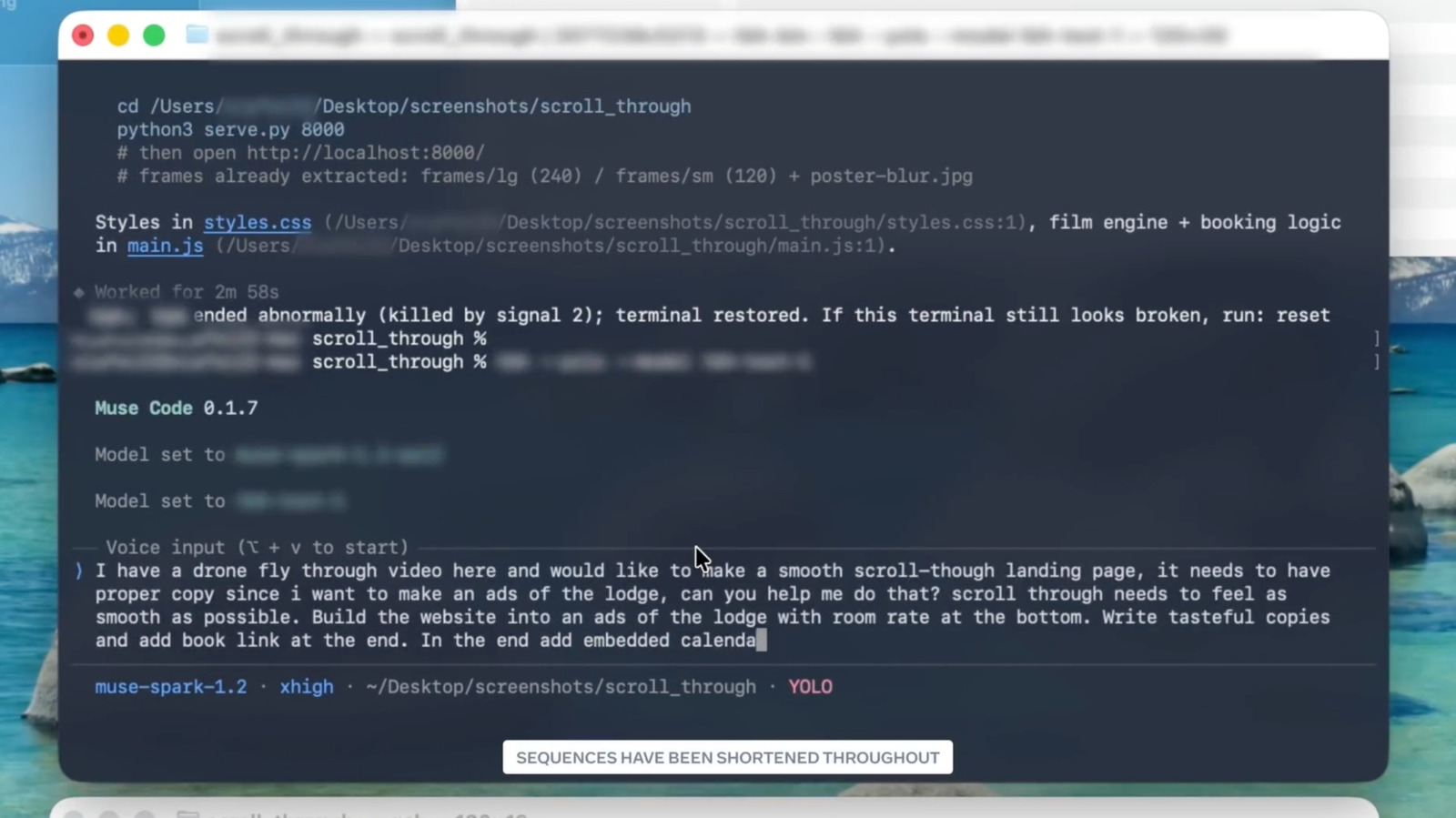
Like its competition, Muse Code can handle software engineering tasks like writing code, planning changes and validating results, making it possible to build working software with text prompts. It can also manage multiple sub-agents and delegate tasks to complete work more efficiently. Meta's announcement includes sample projects like an interactive model of a photon sphere and a Plants vs. Zombies knockoff, and a demo video of the tool building a webpage based on an MP4 file.
Affordability is a key way Meta appears to want to differentiate Muse Code from its competitors. The company says the tool uses the same pay-as-you-go pricing as Muse Spark by default — $1.25 per million input tokens and $4.25 per million output tokens — and in an interview with CNBC, Alexander Wang, Meta's Chief AI Officer, said the company would also offer "a contributor tier that gets you in at a significantly lower cost." That tier would require users to agree to provide feedback to improve the coding agent, according to The Wall Street Journal, and cost $0.10 per million input tokens and $0.20 per million output tokens.
Those prices are cheaper than Anthropic's Sonnet 5 model, which typically costs $3 per million input tokens and $15 per million output tokens. Provided Muse Code works well, the difference could lead companies to choose Meta over its competitors. The same logic has already proven effective for Chinese AI companies: multiple companies switched to Chinese models like DeepSeek to avoid the growing cost of using US AI tools.
[Image text:] cd /Users
/Desktop/screenshots/scroll_through
python3 serve.py 8000
# then open http://localhost:8e00/
# frames already extracted: frames/1g (240)/ frames/sm (120)+ poster-blur.jpg
Styles in styles.css (/Users
Desktop/screenshots/scroll_through/styles.css:1),film engine + booking logic
in main.js (/Users
/Desktop/screenshots/scroll_through/main.js:1).
Worked for 2m 58s
ended abnormally (killed by signal 2); terminal restored. If this terminal still looks broken, run: reset
scroll_through %
scroll_through %
Muse Code 0.1.7
Model set to
Model set to
Voice input (t+ v to start)
I have a drone fly through video here and would like tothake a smooth scroll-though landing page, it needs to have
proper copy since i want to make an ads of the lodge, can you help me do that? scroll through needs to feel as
smooth as possible. Build the website into an ads of the lodge with room rate at the bottom. Write tasteful copies
and add book link at the end. In the end add embedded calenda
muse-spark-1.2 xhigh ~/Desktop/screenshots/scrol1_through
.
YOLO
SEQUENCESHAVE BEEN SHORTENED THROUGHOUT